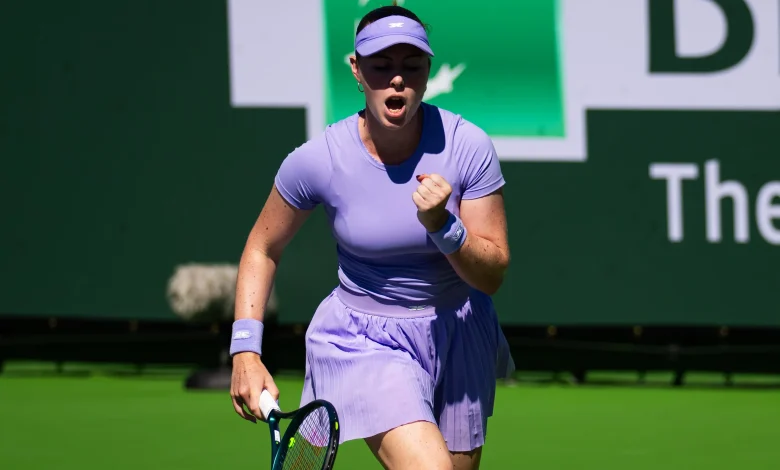
talia gibson, ranked No. 112, turned qualifying entry into a fourth-round appearance at the BNP Paribas Open in Indian Wells, collecting the first Top 20 wins of her career and reshaping the narrative of the tournament’s first week.
What did Talia Gibson do on court?
Talia Gibson won two qualifying matches before eliminating higher-ranked opponents in the main draw. Gibson defeated Ann Li, then 11th seed Ekaterina Alexandrova and 17th seed Clara Tauson to reach the fourth round. The victories over Alexandrova and Tauson were the first two Top 20 wins of Gibson’s career. In the upset of Alexandrova, Gibson won 6-3, 7-5; Gibson entered that match ranked 101 places lower than Alexandrova in the PIF WTA Rankings.
Which other matches framed the first week’s surprises?
The early rounds produced a mix of endurance tests and clean blowouts that together set the stage for Gibson’s rise. Katerina Siniakova prevailed in an epic three-set match that lasted 3 hours and 28 minutes, featuring 268 points played and 37 break-point chances between the players. Camila Osorio recovered from a set down and saved multiple match points to upset 18th seed Iva Jovic in three sets. Separately, Mirra Andreeva recorded a 6-0, 6-0 main-draw victory, the first double bagel at Indian Wells in a decade and the 100th main-draw win of her career. These contrasting results — marathon wins and decisive shutouts — framed a week that allowed a qualifier like Gibson to build momentum and exploit openings in the draw.
Who benefits and who is exposed by this pattern?
Players rising from qualifying, including Gibson, benefited from match rhythm and the opportunity to face seeds who may have been vulnerable after limited time on court. Gibson’s straight-sets win over Alexandrova (6-3, 7-5) illustrates how a lower-ranked player with momentum can convert opportunities when seeds do not find early match sharpness. At the same time, established seeds who met opponents in form saw their positions exposed — the week featured notable escapes and upsets that signaled inconsistency among higher-ranked players in the early rounds.
What does the evidence mean together?
Viewed collectively, the week’s data points suggest a tournament environment that rewarded momentum and match preparedness. Gibson’s path — two qualifying wins followed by successive main-draw upsets, including the first Top 20 victories of her career — fits the larger pattern of the opening rounds: extended three-set battles, dramatic comebacks, and decisive routs all created opportunities for lower-ranked players to advance. The presence of marathon matches and sudden, emphatic results compressed the margin for error for seeded players and amplified the impact of early-form advantages.
Verified fact: Gibson reached the fourth round after qualifying and recorded her first Top 20 wins by defeating Ekaterina Alexandrova (6-3, 7-5) and Clara Tauson. Verified fact: Siniakova’s three-set match lasted 3 hours and 28 minutes with 268 points played. Verified fact: Mirra Andreeva’s 6-0, 6-0 win was the first double bagel in women’s singles at Indian Wells in ten years and marked her 100th main-draw victory.
What should the tournament and public demand next?
Transparency in scheduling, clearer indicators of player form coming into events, and attention to how qualifying players are integrated into main-draw timelines would help contextualize surprise runs like Gibson’s. The tournament field produced a mix of endurance tests and emphatic results that materially affected seed performance; stakeholders — players, coaches, and tournament officials — should examine whether current scheduling and seeding protocols adequately reflect players’ competitive readiness. For now, talia gibson’s run stands as a documented example of how qualifying momentum can translate into breakthrough main-draw success at Indian Wells.