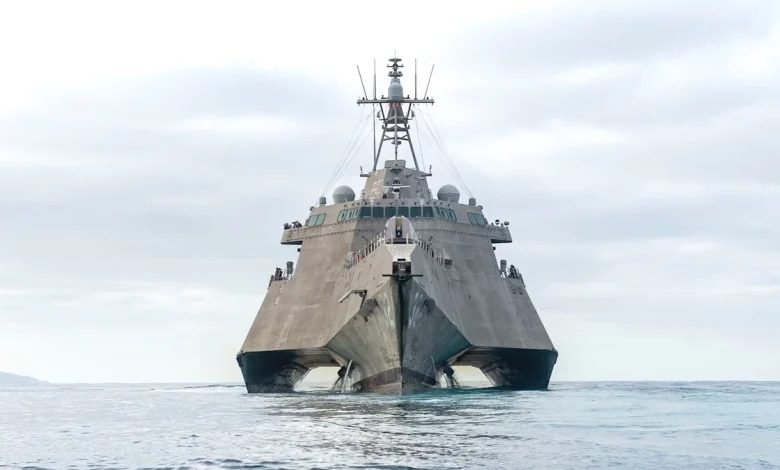
Us Navy Minesweepers are at the center of a sudden posture shift after two littoral combat ships outfitted for mine countermeasures, USS Tulsa and USS Santa Barbara, were photographed in port in Penang, Malaysia, despite having been forward‑deployed to the Persian Gulf earlier this year.
Us Navy Minesweepers: Tulsa and Santa Barbara Appear in Penang
Photographs posted by a spotter show USS Tulsa and USS Santa Barbara at the North Butterworth Container Terminal in the Port of Penang. Images available through the U. S. military’s Defense Visual Information Distribution Service show USS Tulsa was in port in Bahrain at least as of February 9, and separate images show USS Santa Barbara operating in the Persian Gulf on January 30. Commercial satellite imagery examined for port activity in Manama shows no evidence of U. S. warships in that port since February 23.
When asked about the ships’ movements, CENTCOM directed inquiries to the U. S. Navy’s Fifth Fleet, which in turn referred them back to CENTCOM. Requests for comment were also directed to the U. S. Navy and U. S. Indo‑Pacific Command.
How Littoral Combat Ships Replaced Avenger‑Class Minesweepers
The change follows the Navy’s decommissioning last year of half of its Avenger‑class mine countermeasure ships and a planned replacement of those vessels with Independence‑class littoral combat ships equipped with a mine countermeasures mission package. The first LCS with that package arrived in the U. S. Fifth Fleet on May 22, and the USS Santa Barbara and USS Tulsa were recorded as stationed with the Fifth Fleet as of Sept. 25, 2025.
The mine countermeasures mission package carried on the Independence‑class includes towed mine‑hunting sonar, Common Unmanned Surface Vehicles fitted with mine‑sweeping gear, and mine detection and neutralization systems deployed from embarked MH‑60 Sea Hawk helicopters. The LCS approach is to operate outside the immediate mine threat zone and deploy manned and unmanned systems to locate and neutralize mines from a safer distance.
By contrast, traditional minesweepers were built to operate nearer or directly inside minefields. Those ships were designed with non‑magnetic signatures and low acoustic footprints so they could work closer to mines and employ sonar, cable cutters, and detonation devices. The Navy once built 14 deployable Avenger‑class ships, which served in major Gulf conflicts and participated in large post‑war mine‑clearance efforts off Kuwait.
Strait Of Hormuz Risks, Combat Readiness And What Comes Next
Concerns over mine warfare in the region have increased after Iran began laying mines in the Strait of Hormuz this week, and U. S. Central Command announced it had struck 16 Iranian mine‑layers. The extent to which mines have been placed in the Strait remains unclear, a factor that will shape any effort to reopen the waterway.
The littoral combat ships fitted with the mine countermeasures package have not yet been used in combat for this mission; if they are used during Operation Epic Fury to address Iranian mines, it would mark a first for the LCS MCM package. At the same time, the current disposition of other Independence‑class ships that had been forward‑deployed to the Middle East, including one whose status is not known, has not been publicly clarified, and it is not known whether other mine countermeasures vessels will be sent to the region.
With the Avenger‑class largely retired and LCS‑based systems designed to work at standoff distances, planners will need to weigh how to clear and secure the Strait for commercial traffic while adapting to an evolving mine threat whose scale and location are still being determined.
Officials have not yet outlined next steps or a timeline for any redeployments, leaving the immediate posture and operational plans for U. S. mine‑countermeasure forces in the region unsettled.