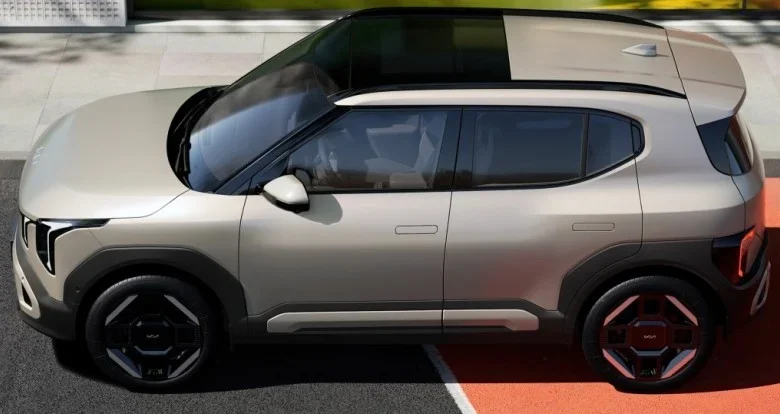
Kia unveiled the EV2 in early January and the car was later spotted running uncamouflaged on Korea’s streets, confirming the production look shown in official images. The appearance of the EV2 and the arrival of the hyundai Inster set up a direct comparison that highlights where each maker has traded space, range and price to hit affordable city‑EV targets.
Kia EV2 Road Appearance
The EV2 was seen with no camouflage in a short video on Korean streets, matching the official design images and confirming that the layout and exterior will reach showrooms as presented. The EV2 uses the 400V platform rather than an 800V system, offers 42. 2 kWh and 61 kWh battery options, and includes both 11 kW and 22 kW AC charging, plus two 12. 3″ touchscreens and a 5. 3″ climate control screen inside. The pattern suggests Kia has prioritized keeping costs down and delivering familiar cabin tech while accepting slower charging compared with higher‑voltage systems.
Hyundai Inster Size and Price
The hyundai Inster is presented as the more compact rival: length 3, 825 mm, width 1, 610 mm, height 1, 575 mm and a wheelbase of 2, 580 mm, versus the Kia EV2’s length 4, 060 mm, width 1, 800 mm, height 1, 575 mm and wheelbase 2, 565 mm. Luggage capacity differs too: the EV2 lists 362 liters, while the Inster offers 238 liters in standard seating, 351 liters with the rear seats pushed forward, and up to 1, 059 liters with seatbacks folded. The figures point to a clear trade‑off where Kia delivers more cabin and cargo room while Hyundai targets city maneuverability and packaging efficiency.
Power and range split the models in other ways: Kia’s two battery choices are paired with quoted ranges of up to 317 km for the 42. 2 kWh pack and up to 448 km for the 61 kWh pack, while the Hyundai Inster’s batteries are listed as 42 kWh with 327 km and 49 kWh with 370 km. Power outputs differ as well: Kia’s variants are expected to deliver more than 74 kW, while the Inster is offered with 71 kW and 85 kW front‑wheel‑drive options. Price signals also vary: the EV2 has been described as expected to start around €29, 900 in one estimate and has been estimated at about €25, 000 in another, while the Inster is listed from €25, 140 before discounts or from €16, 630 with discounts applied. These numbers suggest buyers will weigh range and interior room against sticker price and available incentives.
Subsidy and production notes sharpen that buyer calculus: the EV2’s production in Slovakia may qualify it for a Plan Auto+ subsidy of €4, 500, whereas the Inster, assembled outside the EU, is capped at a maximum Plan Auto+ support of €3, 375. That subsidy gap narrows headline price differences and could sway cost‑sensitive buyers more than raw list prices.
Performance figures for the EV2 have not been published yet, and full specifications remain unrevealed for some trims; the EV2’s base Air trim is known to include 16‑inch alloy wheels, LED headlights, a six‑speaker audio system, dual‑zone climate control and roof rails, while the Inster’s Klass trim lists 15‑inch steel wheels and driver‑assistance features such as an electronic parking brake, hill‑start assist and emergency braking. The detail gap suggests manufacturers are still finalizing what they will present to buyers beyond core battery and packaging choices.
What remains unconfirmed is the EV2’s exact power and full European pricing; performance numbers for the Kia EV2 have not been published and final prices in Spain were not announced. If those specifications and final pricing hold in a way that favours range or subsidy eligibility, the data suggests shopper preferences between space and cost could decisively tilt toward one model over the other.