Saturday at 11: 00 a. m. ET, Environment Canada-confirmed readings showed Downtown Hamilton reached 20. 4 C while the Toronto airport hit 17. 6 C, breaking the old March 7 record. Hamilton Weather remains notable as St. Catharines and Vineland also recorded 20. 3 C, and conservation authorities issued high-water watches.
Environment Canada Confirmed Records and Local Highs
Confirmed: Environment Canada says the Toronto airport recorded a high of 17. 6 C on Saturday, surpassing the previous March 7 record of 17. 2 C set in 1860. Confirmed: Vineland reached 20. 3 C by 11: 00 a. m. ET, and a St. Catharines-area station also hit 20. 3 C. Confirmed: Downtown Hamilton reached 20. 4 C, noted as its second-earliest 20-degree reading; Hamilton’s earliest 20 C was recorded on March 6, 1876.
Hamilton Weather: Downtown 20. 4 C and Regional Rain Totals
Confirmed: A low-pressure system tracked over Ontario on Saturday and brought snow and rain to northeastern sections of the province, while southern Ontario saw rain, fog and mild temperatures. Confirmed: Wiarton recorded more than 40 millimetres of rain during the system. Confirmed: three Ontario locales reached 20 C on the same day, marking the province’s first 20-degree occurrences of 2026.
Bruce Road 7 Washout, Ponding and Conservation Authority Watches
Confirmed: The rapid melt and rainfall led to significant snow melt and reports of ponding on roads in several areas. Confirmed: sections of Bruce Road 7 were reported washed out. Confirmed: dense fog produced accidents, and several Greater Toronto Area conservation authorities issued watches or statements about high water and breaking ice. Unconfirmed as of 11: 00 a. m. ET: the full extent of road damage beyond the reported sections of Bruce Road 7 and the total number of affected roads.
Still, one new observable fact arrived with each reading: Vineland’s 20. 3 C peak was logged by 11: 00 a. m. ET; Downtown Hamilton’s 20. 4 C is recorded without dispute in the local observations; Toronto’s 17. 6 C is a confirmed new March 7 high at the airport station. Each of these confirmed readings carries a concrete number and a place name that local officials and the public can track.
Yet, several elements remain under review. Unconfirmed as of 11: 00 a. m. ET: the timeline for municipal road repairs and which specific roads beyond Bruce Road 7 will require closures or reconstruction. Unconfirmed as of 11: 00 a. m. ET: whether additional 20-degree readings will be logged in nearby communities before Monday. Environment Canada and local conservation authorities are the confirmed agencies providing updates.
The precise triggers that will clarify the picture are also clear. Confirmed: further Environment Canada temperature and precipitation readings will show whether the warm spike persists. Confirmed: updated statements or watch changes from conservation authorities will indicate whether high-water conditions are worsening or improving. If Environment Canada posts additional 20-degree measurements on Monday, conservation authorities are expected to expand or revise watches in the same day.
The stakes differ sharply by outcome. If temperatures and rainfall remain elevated and water levels in creeks and rivers do not fall, then additional ponding and road damage are expected; local travel disruptions and more washouts are the immediate operational consequences. If temperatures cool and precipitation diminishes, current ponding and the risk to roads should ease, and conservation authorities may downgrade watches to statements.
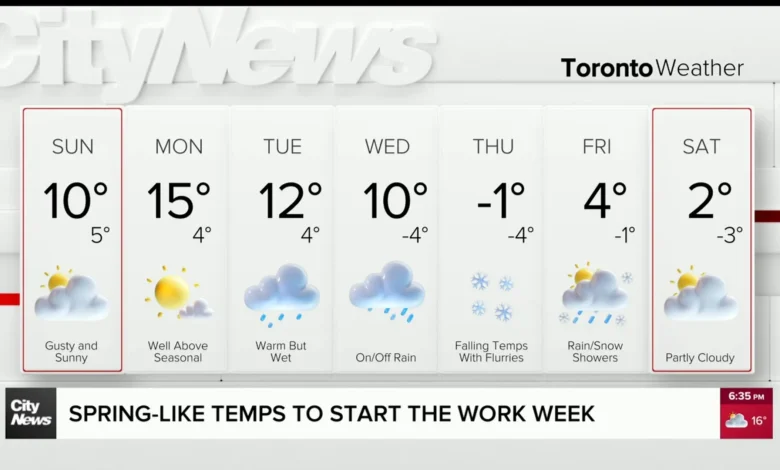
Confirmed next event that will move the story: temperatures are expected to pick up on Monday, which is the near-term forecasted development tied directly to ongoing melt and runoff. Conditional: If Environment Canada confirms further 20-degree readings on Monday, conservation authorities are expected to broaden high-water watches by Monday, affecting more local roads and creek-side areas.