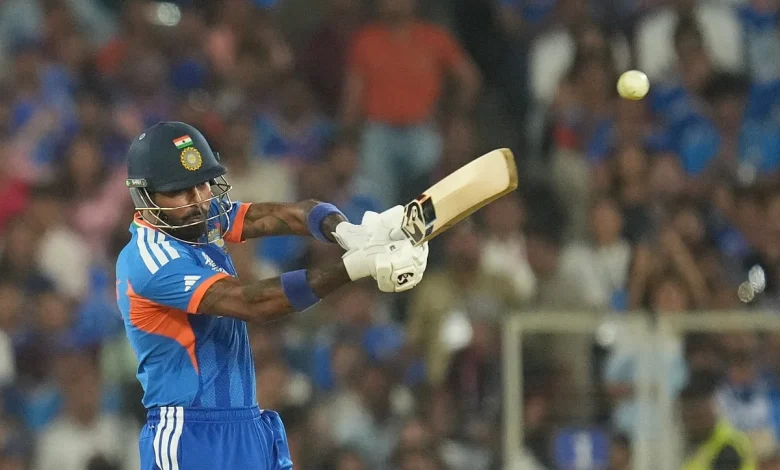
As of Sunday at 9: 30 a. m. ET, India were 220 for 4 after 18 overs in the T20 World Cup final against New Zealand in Ahmedabad, with Tilak Varma and Hardik Pandya accelerating after sanju samson’s 89. What remains unresolved is India’s final first-innings total and whether the early onslaught holds in New Zealand’s reply, to be clarified by the last two overs and the Kiwis’ powerplay.
Abhishek Sharma’s 18-ball fifty and New Zealand’s first strike by Rachin Ravindra
Abhishek Sharma, under scrutiny after seven innings for just 89 runs at 12. 71 with three ducks and a strike rate of 130. 88, detonated in the final. He blasted 52 off 21 balls with 6 fours and 3 sixes, bringing up a fifty in 18 deliveries. That surge powered India to 92/0 in the powerplay and a 98-run opening stand with Sanju Samson before the first wicket fell at 98/1 in 7. 1 overs.
New Zealand’s first breakthrough arrived when Rachin Ravindra found a faint edge to wicketkeeper Tim Seifert to remove Abhishek for 52. Until then, India had sprinted: 12/0 after two overs, past 50 by the fourth, and cruising at 92/0 by the sixth. Across lengths, the Kiwi seamers were put under pressure in the powerplay.
The assault carried statistical weight beyond the scoreboard. Abhishek produced the fastest fifty of the 2026 tournament, hit a boundary every 2. 33 balls, and logged 80. 77% of his runs in fours and sixes. India’s team hundred in 7. 2 overs set a knockout-stage pace marker that reframed the match’s tempo before the middle overs even began.
Sanju Samson’s dismissal at 89 and India’s late-over equation with Neesham
Sanju Samson narrowly missed a century, departing for 89 when James Neesham slipped in a high full toss that he could not clear; Cole McConchie completed a running catch at long on. Ishan Kishan, who had struck a rapid fifty, also fell to Neesham. Soon after, Suryakumar Yadav’s attempt to lift the rate ended his brief stay.
Still, India were positioned for a finishing kick. At 18 overs, the score read 220/4 with Tilak Varma and Hardik Pandya pushing the run rate. What remains unconfirmed as of 9: 30 a. m. ET is how many Varma and Pandya can extract from the final two overs and how New Zealand distribute their remaining deliveries among quicks such as Lockie Ferguson, Matt Henry, and Jacob Duffy alongside captain Mitchell Santner’s options.
The unresolved hinge is simple: if India capitalize on the death overs, New Zealand’s chase calculus tightens early; if the Kiwis contain the finish, the target’s pressure profile moderates. Within that frame, sanju samson’s 89 has already banked a platform that reduces India’s dependence on a flawless finish but does not eliminate it.
Mitchell Santner’s bowling call, India’s unchanged XI, and the chase-defining phases
Mitchell Santner won the toss and chose to bowl against the defending champions. New Zealand reinstated pacer Jacob Duffy, listed as coming in for off‑spinning all-rounder Luke McConchie. India retained the same eleven that faced England in the semifinals in Mumbai: Abhishek Sharma, sanju samson (w), Ishan Kishan, Suryakumar Yadav (c), Tilak Varma, Hardik Pandya, Shivam Dube, Axar Patel, Varun Chakaravarthy, Arshdeep Singh, and Jasprit Bumrah. New Zealand’s XI featured Seifert (w), Finn Allen, Rachin Ravindra, Glenn Phillips, Mark Chapman, Daryl Mitchell, James Neesham, Santner (c), Henry, Ferguson, and Duffy.
Two discrete phases will determine whether India’s dominance carries through. First, the immediate finishing window: Varma and Pandya’s strike-rate decisions against New Zealand’s end-overs mix will set the final target. Second, New Zealand’s powerplay reply: Allen, Ravindra, and Phillips will confront a new-ball group led by Bumrah and Arshdeep, with Varun Chakaravarthy’s variations and Axar Patel’s control waiting to test any rebuild.
Conditional paths are clear. If New Zealand’s top order mirrors India’s early tempo, the required rate can stay stable into the middle overs. If India’s quicks find movement or early edges, scoreboard pressure could force shot-selection errors by the sixth over. Either scenario is bounded by confirmed factors: a platform built by Abhishek and Samson, a solid hand from Kishan, and the availability of India’s frontline attack.
For now, only two concrete triggers remain before the balance of risk becomes clearer: India’s final two overs with Varma and Pandya at the crease, and New Zealand’s first six overs of reply with Santner’s field settings under the lights in Ahmedabad.
The next confirmed sequence is the completion of India’s 20 overs followed by New Zealand’s chase. If India finish strongly, New Zealand are expected to front‑load intent in the powerplay; if the finish is contained, the visitors can pace the pursuit deeper into the middle overs.