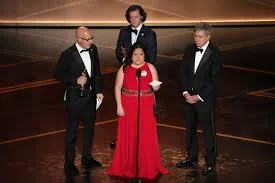
The documentary short all the empty rooms won the Oscar for Best Documentary Short on Sunday night, memorializing children killed in school shootings by focusing on the bedrooms they never returned to. At the 98th Academy Awards in Hollywood, director Joshua Seftel accepted the statuette alongside journalist Steve Hartman, producer Conall Jones and Gloria Cazares, whose 9-year-old daughter, Jackie, was killed in the 2022 Uvalde school shooting.
‘All The Empty Rooms’ Team Shares the Stage
Seftel told the audience that the four bedrooms featured belong to Hallie, Gracie, Dominic and Jackie, young victims of school shootings whose lives are recalled through the spaces they left behind. He then invited Cazares to speak.
Wearing a red dress and a pin bearing Jackie’s image, Cazares described how her daughter’s room has remained untouched. “My daughter, Jackie, was nine years old when she was killed in Uvalde. Since that day, her bedroom has been frozen in time, ” she said. “Jackie is more than just a headline. She is our light and our life. ” She added that gun violence is now the leading cause of death for children and teens, and urged viewers to consider what the film shows: “We believe that if the world could see their empty bedrooms, we’d be a different America. ”
The win capped a yearslong effort chronicled by Seftel, Hartman and photographer Lou Bopp, who set out to capture the private spaces that vividly reflect children’s personalities, ambitions and everyday routines, now marked by absence. The project’s central idea—that confronting absence makes the loss inescapably real—was underscored by the onstage moment with Jackie’s mother.
Seven Years Documenting Loss
Over seven years, the filmmakers visited families and filmed rooms that remain virtually untouched. Bopp has written about the small, enduring details that reveal who the children were: a hair tie looped over a doorknob, a toothpaste tube left uncapped, a ripped ticket for a school event. In Jackie’s room, there was chocolate she saved for a special day that never came and an “About Me” chalkboard where she had written that she wanted to become a veterinarian.
Hartman traveled to Uvalde, Texas, after the shooting at Robb Elementary School, where 19 children and two teachers were killed. Cazares invited the team into her home to help others grasp the weight of what families carry. She said the world needs to imagine what is often described as unimaginable, and that seeing a child’s room “completely just speaks of who she was. ”
The film runs about half an hour and is distributed by Netflix, bringing the stories to a wide audience after its awards-season recognition. The Oscar for Best Documentary Short places the work firmly in this year’s highest-profile honors and amplifies its message at a moment when many families remain in mourning.
Why This Win Matters Now
The Oscar spotlights a story built from personal spaces and quiet artifacts rather than statistics or policy debates. By centering parents and their children’s rooms, the filmmakers present a portrait of loss that is at once intimate and widely recognizable in communities affected by school shootings.
Onstage, the filmmakers emphasized that the film is about four specific children—Hallie, Gracie, Dominic and Jackie—rather than an abstract issue. Cazares’s remarks framed the win as a platform to keep her daughter’s memory present and to encourage others to see what families see each day in those rooms. Her words echoed a core purpose of all the empty rooms: to make absence visible and, in doing so, harder to look away from.
As audiences seek out the short in the wake of its Academy Award, the filmmakers’ years of documentation—and the decision by families to preserve the bedrooms as they were—are likely to continue shaping the public conversation. The attention brought by the win ensures that the images of those spaces, and the children who filled them, will reach far beyond the ceremony.