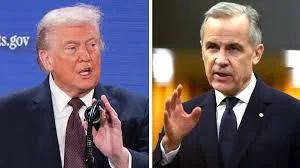
President Donald Trump has again referred to Prime Minister Mark Carney as the “future Governor of Canada. ” Donald Trump Canada now frames a pattern of public remarks and social posts that conflict with firm denials from Canada’s leaders and a measured public response; this article examines the gap between repeated rhetorical jabs and the record of official pushback.
Donald Trump Canada: the social posts naming Mark Carney ‘future Governor’
Confirmed: In a recent social media post the President said he was working with Michigan’s governor on efforts to protect the Great Lakes from invasive Asian Carp and listed other U. S. governors he planned to ask to participate. That post explicitly included the line identifying Mark Carney as “the future Governor of Canada, Mark Carney, ” and listed governors from Illinois, Wisconsin, Minnesota, Pennsylvania, Ohio, Indiana and New York as invited collaborators.
Documented: This was not an isolated social post. Earlier social media messages by the President used the “governor” label for the Canadian leader when discussing trade and border matters, and one message referenced Canada as a potential “Drop Off Port” in connection with goods movement. Those earlier posts used the same language device of labeling Canadian leaders with U. S. subnational titles.
Mark Carney: denials, the ‘president’ exchange, and public replies
Confirmed: Prime Minister Mark Carney has publicly rejected the notion that Canada would become a U. S. state. He has said in a public statement that it will never happen. In a separate public answer he declined to address every social media remark or jab, saying he “won’t comment on every ‘tweet, ‘ or ‘truth, ‘ or comment from whoever” and that he “can handle it. “
Documented: At an international summit in October 2025 the President called Carney “president” of Canada. The two men exchanged a light moment when Carney approached to correct the title, joking that he had “upgraded” the President. The President smiled, patted him on the back and said, “at least I didn’t say governor, ” which underlines a pattern of title-based jibes rather than formal diplomatic rebuke in that encounter.
Canada: annexation talk, tariffs, and the public response described
Confirmed: The President has suggested repeatedly that Canada should be a U. S. state, calling it the “51st state” in public remarks last June. Canada’s leaders, including the previous prime minister, have rejected the idea; Carney reiterated that it will never happen. The President also said in another public forum that “Canada lives because of the United States, ” a remark that prompted Carney to post a video rebuttal saying, “Canada thrives because we are Canadian, ” and declaring, “This is our country. This is our future. The choice is ours. We choose Canada. “
Documented: The President’s rhetoric and the tariffs his administration has levied on Canadian goods, together with the administration’s broader agenda, have been followed by public responses inside Canada. The record notes boycotts of American products, including liquor brands, and a drop in Canadian travel to the United States for several months in a row. Those consumer and travel reactions indicate measurable pushback tied to the rhetoric and policy actions referenced above.
What remains unclear is whether the President’s repeated labeling of the Canadian leader as a “governor” and his talk of a U. S. annexation reflect sustained policy intent or rhetorical provocation. The context does not confirm any formal policy proposal to change Canada’s status; it documents repeated public remarks, social media posts, denials from Canadian leaders, and tangible consumer responses.
To resolve that central question the specific evidence would be a formal, public policy step: if the President were to present an official proposal or legislative initiative to alter Canada’s political status, it would establish that the repeated remarks reflected an actual policy objective rather than rhetorical provocation.