An extensive investigation asserts that the anonymous street artist Banksy is Robin Gunningham, who later changed his name to David Jones. The probe’s central claim — banksy identified as robin gunningham — now faces legal and ethical challenges from the artist’s attorney, and raises questions about how conclusive the assembled evidence really is.
Robin Gunningham, David Jones, and the investigation’s documentary trail
Investigators describe a years-long effort to piece together the identity of the U. K. graffiti artist through travel records, photographs, and a historical paper trail. They state that Banksy is a Bristol native, not musician Robert Del Naja, and that Gunningham at some point adopted the name David Jones.
The dossier pulls together several strands that purport to establish authorship and presence:
- A journey to Ukraine, where the artist was photographed and met with locals, produced imagery and witness accounts that the team interprets as consistent with Gunningham.
- A fallout with Jamaican photographer Peter Dean Rickards, who is said to have posted images of Banksy’s face, supplied additional visual clues.
- A 2000 arrest in New York yielded a signed, handwritten confession, presented as a key documentary artifact in the timeline.
- At Sotheby’s London, when Girl With Balloon shredded immediately after sale and later became Love Is in the Bin, a man resembling Gunningham was alleged to be in attendance, watching the crowd’s reaction.
Taken together, these elements form the core of the identification narrative. The claim that the artist is not Del Naja features prominently, with the investigation asserting that while the musician was in Ukraine in 2022, he was accompanied by another man who they argue was the graffiti artist himself.
Mark Stephens, anonymity, and the risk argument
Banksy’s lawyer, Mark Stephens, challenges the accuracy and wisdom of publishing the identification. He wrote that his client does not accept many details in the inquiry as correct. Stephens further argued that revealing the identity would violate the artist’s privacy, interfere with the art, and put him in danger.
Stephens framed anonymity as a public good. He argued that working under a pseudonym protects freedom of expression and enables creators to speak truth to power without fear of retaliation, censorship, or persecution. This position presents a sharp counterpoint to the investigation’s stated premise that the public has a deep interest in understanding the identity and career of a figure with significant and enduring influence on culture, the art industry, and international political discourse.
That tension runs through the case: the artists’ safety and creative latitude versus an asserted cultural interest in unmasking a prolific and polarizing figure whose work commands vast attention and money. The identification effort also revives a 2008 report that made the same claim, suggesting a long-running thread that investigators now say they have strengthened with fresh material.
Banksy Identified As Robin Gunningham versus Robert Del Naja rumors
The investigation seeks to close the door on the long-circulating theory that Banksy is Robert Del Naja by separating the musician’s known movements from sightings tied to the artist. Editors of the probe point to shared geography in Ukraine in 2022 but conclude that the companion was the graffiti artist, not the musician himself.
Yet unresolved issues remain. The context does not confirm the authentication chain for the 2000 New York confession or whether it directly links to Gunningham or to the later name, David Jones. Photographs described as showing the artist’s face, including those tied to Peter Dean Rickards, are not presented here with verifiable metadata. Presence at Sotheby’s London, even if visually compelling, does not by itself establish authorship of the shredding stunt or any specific work. These are open questions about provenance, verification, and attribution.
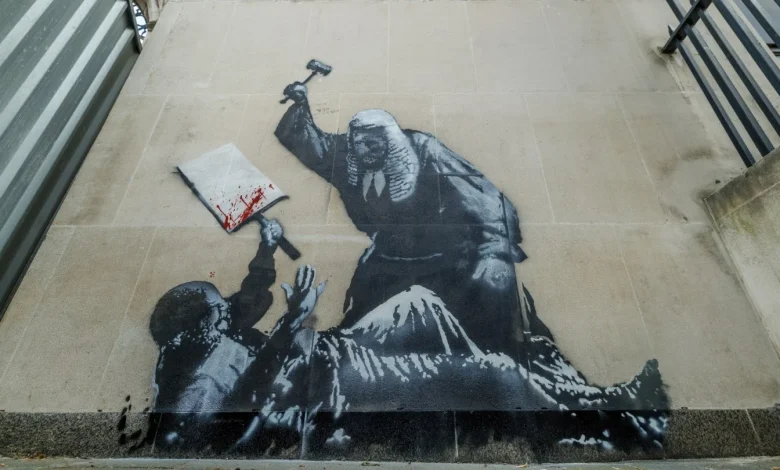
There is a documented pattern of high-impact public acts attributed to the artist. Girl With Balloon’s transformation into Love Is in the Bin after an auction-sale shock moment later yielded a price of $25 million. Another work last September depicted a judge attacking an unarmed protester with a gavel, captioned Royal Courts of Justice, and it was swiftly removed. Alongside these events, some peers tell the investigation they believe the artist unfairly evades the law, a claim that sits uneasily with the fact that graffiti on public property is illegal in the U. K.
For now, banksy identified as robin gunningham remains a claim supported by the investigation’s compilation of photos, travel sightings, and a decades-old document, not a court-tested fact. Stephens’s challenge underlines both factual disputes and the potential risks of unmasking an artist whose anonymity is a defining element of the work’s power and protection.
The context does not confirm whether additional records will be released or whether the artist will respond beyond Stephens’s statements. A clear resolution would hinge on verifiable documentation or an unequivocal, on-the-record confirmation tying Robin Gunningham — or the later name David Jones — to the creation and control of specific works. If such confirmation emerges, it would establish the identification claim beyond dispute within the public record.