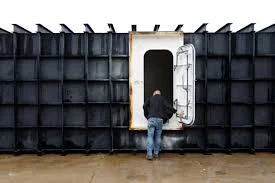
Ron Hubbard and his company, Atlas Survival Shelters in Sulphur Springs, Texas, are seeing a surge in orders just as members of Donald Trump’s Cabinet have purchased bomb-proof bunkers. This comparison asks: does the rush represent elite precaution limited to a few officials, or a wider, revenue-driving market shift for Atlas?
Atlas Survival Shelters: production, pricing and the sales spike
Atlas Survival Shelters constructs hundreds of galvanized steel shelters each year at its Sulphur Springs factory, Ron Hubbard says, and Hubbard reported that orders have increased “tenfold” since the United States and Israel attacked Iran earlier this month. The company’s catalog lists underground options from tornado bunkers to hidden gun rooms, with prices ranging from $200, 000 to $5 million, and high-end units that may include mud rooms, swimming pools, cinemas, armories and gun ranges.
Atlas has averaged $2 million a month in sales for 2026 so far, Hubbard said, and he predicted that sales could jump as much as $50 million next month. Hubbard also described his customer base as largely “Christian, conservative CEOs, ” and said more tech moguls have recently approached him for shelters.
Trump Cabinet purchases: two officials and the elite buyer profile in the Bunker market
Two members of Donald Trump’s Cabinet have recently purchased bomb-proof bunkers, creating a high-profile signal of demand among senior officials. One Cabinet member even texted Hubbard asking: “When will my bunker be ready?” That purchase sits alongside other elite orders Hubbard declined to name, but he said he has built shelters for several of the richest men on the planet.
Hubbard also noted that last year he met a crowd at Mar-a-Lago to advertise shelters, underlining how Atlas markets directly to wealthy and politically connected buyers. Those purchases by Cabinet members align with Hubbard’s statement that much of his clientele is conservative business leadership rather than a broad-based public market.
Atlas Survival Shelters vs. Trump purchases: scale, clientele, and how they diverge
On scale, Atlas reports hundreds of shelters built annually and a potential jump from $2 million monthly sales in 2026 to $50 million next month, which suggests company-wide demand far exceeds the handful of Cabinet purchases. Yet on clientele, the two Cabinet buys underscore that high-profile officials form part of the same elite cohort—conservative CEOs and wealthy individuals—that Atlas identifies as its main market.
On messaging, Hubbard’s characterization of being “inundated with calls” and a tenfold order increase ties directly to recent military action involving the United States, Israel and Iran, while the Cabinet members’ purchases provide a political spotlight that can amplify demand among similar buyers. Still, the numerical reach of Atlas’s business—price ranges of $200, 000 to $5 million and high-end amenities—shows the company depends on large, concentrated sales rather than mass-market penetration.
| Metric | Atlas Survival Shelters (company) | Trump Cabinet purchases (two officials) |
|---|---|---|
| Reported order change | “Tenfold” increase since attacks on Iran | Two purchases confirmed |
| Production | Hundreds of galvanized steel shelters built yearly | Individual bespoke bunkers |
| Price range | $200, 000 to $5 million | Not disclosed for specific purchases |
| Primary clientele | “Christian, conservative CEOs” and wealthy individuals | Senior government officials within Donald Trump’s Cabinet |
That table highlights where the two sides overlap—wealthy, elite buyers—and where they differ—scale and company-wide revenue versus discrete, high-profile purchases.
Casualty figures from the conflict provide part of the backdrop for this market shift: seven U. S. soldiers have been killed, more than 20 Iranian officials have died, and more than 1, 200 Iranian civilians have been killed, including dozens of children at a girls’ school in the country’s south; one U. S. assessment found that strike was “likely” the fault of American forces. Those facts help explain why Hubbard says calls intensified after the attacks.
Finding: The direct comparison shows that elite, high-profile purchases—exemplified by two Cabinet members—help amplify demand, but Atlas’s reported production capacity, price bands and projected sales leap indicate the company’s current boom is a business-level phenomenon rather than a signal of widespread civilian adoption.
Next confirmed data that will test this finding is Atlas’s sales for the upcoming month: Hubbard’s projection that sales could reach $50 million next month will show whether the surge is sustained across the company. If Atlas maintains a jump from $2 million to $50 million in monthly sales, the comparison suggests the conflict-driven demand has broadened beyond isolated elite buys into a firmwide market expansion.