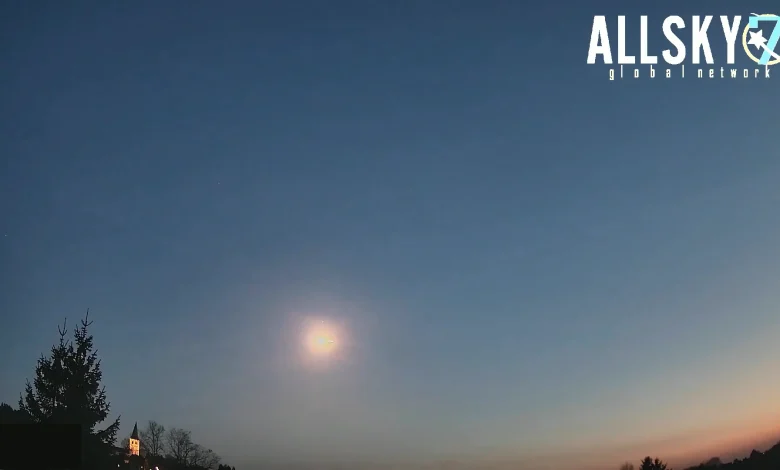
One house in the German town of Koblenz-Güls was struck by fragments after a bright fireball crossed northern Europe, leaving a hole in a roof and no reports of physical injury. The European Space Agency is analysing the event as Meteorite fragments were reported to have fallen in the area during the same blaze seen across several countries.
Meteorite Damage in Koblenz-Güls
At least one house in Koblenz-Güls was hit by small pieces produced when the fireball fractured. A fragment punched a hole about the size of a football into the roof of a home in the Guels district. There are no reports of physical injury from those strikes.
Fragments struck homes and buildings in Germany. The impact on that one roof provides a concrete measure of how pieces that survive atmospheric entry can reach inhabited areas.
ESA’s Planetary Defence team analyzing the 8 March 2026 fireball
The event occurred at 1: 55 pm ET on Sunday 8 March 2026, when a very bright fireball travelled from the southwest to the northeast and glowed for approximately six seconds. Observers in Belgium, France, Germany, Luxembourg, and the Netherlands saw the trail in the sky before the object fractured into pieces.
Dedicated meteor cameras, including the European AllSky7 fireball network, and many mobile phones and other cameras recorded the phenomenon. Some observers heard the event from the ground. The Planetary Defence team in ESA’s Space Safety Programme is using available data to estimate the size of the object, and currently assess it to have been up to a few metres in diameter.
Objects in this size range strike Earth from once every few weeks to once every few years. The timing and direction of the impact indicate the object was likely not visible to large-scale telescope sky surveys that scan the night sky for such objects. To date, there have been only 11 successful detections of natural space objects prior to their atmospheric entry.
AllSky7 network and cross-border recordings from Belgium to the Netherlands
Cameras in the AllSky7 fireball network captured the fireball, and recordings came from many dashcams and mobile phones. Observations spanned multiple countries: Belgium, France, Germany, Luxembourg, and the Netherlands. The wide set of recordings is central to ESA’s analysis of the trajectory and break-up pattern.
That collection of images and videos, together with reports of audible effects, is what allowed investigators to narrow the direction and timing of the passage and to identify where fragments reached the ground.
For residents in Koblenz-Güls, the struck roof is the immediate, human-scale evidence of a space object that began as a fireball high above Europe and ended as meteorite fragments on a street. ESA’s Planetary Defence team is working through the recorded data to refine its size estimate and the likely fall area. Further updates will be provided as new information becomes available.