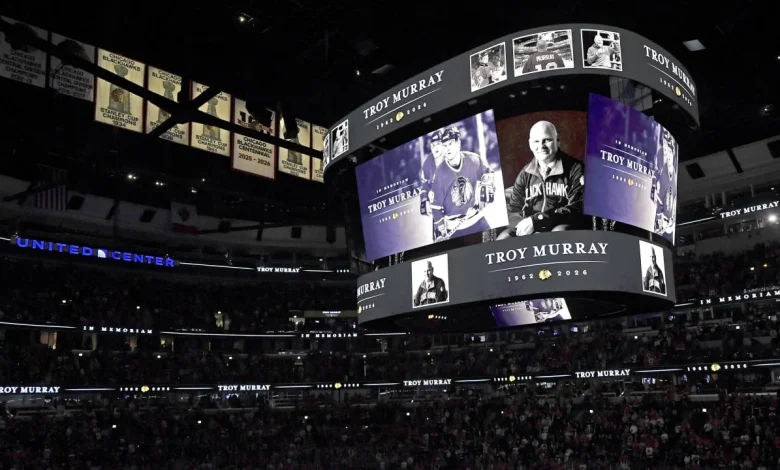
In a subdued pregame ritual, the chicago blackhawks paused for a moment of silence to honor Troy Murray, the former captain and longtime broadcaster whose connection to the club spanned decades. The tribute came ahead of the team’s game against the Mammoth and followed Murray’s death at 63 after a nearly five-year battle with cancer. The ceremony underscored Murray’s dual identity within the organization as both player and ambassador.
Chicago Blackhawks Hold Moment of Silence
The Chicago Blackhawks staged a formal tribute and moment of silence recognizing Murray’s lasting impact on the franchise ahead of their matchup with the Mammoth. The organization acknowledged Murray’s roles on and off the ice: a player who spent parts of 12 seasons with the club and later a broadcaster and alumni leader who kept active ties to current players and fans. The gesture served as an immediate organizational expression of mourning and respect.
Career and Legacy in Numbers
Troy Murray’s professional record paints a picture of a durable two-way center and a veteran presence in the locker room. He played 914 regular-season NHL games, collecting 230 goals and 354 assists for 584 points, and added 17 goals and 26 assists for 43 points across 113 playoff games. A third-round pick of the Blackhawks in 1980, Murray spent 15 seasons in the NHL across five franchises and was recognized with the Selke Trophy in 1985-86 as the league’s premier defensive forward. He capped his playing career as a Stanley Cup champion in his final NHL season with the Avalanche in 1996. Beyond raw totals, Murray’s tenure included parts of 12 seasons directly tied to the chicago blackhawks, a tenure that formed the foundation for his later roles with the club.
Team Statement and Community Resonance
The Chicago Blackhawks issued a statement expressing deep sorrow and reflecting on Murray’s presence within the organization. The statement said the organization was “deeply heartbroken” and noted that Murray was “the epitome of a Blackhawk” with a presence felt “in every corner of our organization over the last 45 years. ” It highlighted his work with the Blackhawks Alumni Association, his frequent support for the team’s foundation and his role as a radio color commentator. The club also emphasized Murray’s character, recalling that during his long and hard battle with cancer, he often showed a refusal to give up and brought levity to the press box with timely jokes.
Those ties with the chicago blackhawks manifested in institutional roles after his playing days: a broadcaster who brought the game to fans night after night and the president of the alumni association who connected generations of players and supporters. The organization framed those activities as part of a broader legacy that will influence internal culture and community outreach moving forward.
As the team and its supporters absorb the loss, the immediate ripple effects are tangible: a moment of silence at a home game, formal remembrance from the organization and an intensified focus on the relationships Murray fostered over decades. His career statistics and accolades will remain a record of on-ice achievement, while his off-ice contributions will likely shape alumni engagement and charitable activity tied to the franchise.
How the chicago blackhawks and their community choose to carry Murray’s spirit forward—through alumni programs, broadcast tributes or renewed community initiatives—remains an open question that will shape his enduring imprint on the club.