Why this matters now: jack carr frames the immediate human toll of a campaign he calls a “maximum pressure campaign” with no clear off‑ramp — meaning families of U. S. service members, frontline personnel and ordinary Iranians are likely to feel consequences first. That dynamic reshapes how policymakers and military planners will have to balance pressure with paths for de‑escalation.
Jack Carr and the immediate human impact
Jack Carr, identified in recent coverage as a former Navy SEAL, has emphasized that the current U. S. approach to Iran lacks an exit strategy. His assessment centers on human and operational exposure: when pressure is sustained without a defined off‑ramp, those closest to the fighting and those living under contested authority face the earliest harms and instability.
Here’s the part that matters: that framing changes how the public evaluates both military action and political planning. If pressure is intended to change behavior, the absence of a clear political transition or governance plan increases the risk of prolonged violence and civilian disruption.
Event details and political responses embedded in the assessment
What has been reported in recent updates: a U. S. attack on Iran has been characterized as part of a maximum pressure campaign, and commentary around the operation points to a lack of an off‑ramp for Iran. Separate coverage notes that Israel struck Iranian leadership in a coordinated action that killed many leaders, including the country’s supreme leader and the head of its Revolutionary Guard Corps; the country’s president and the supreme leader’s son appear to remain alive. Recent updates indicate six U. S. service members have been killed in the crisis; details may evolve.
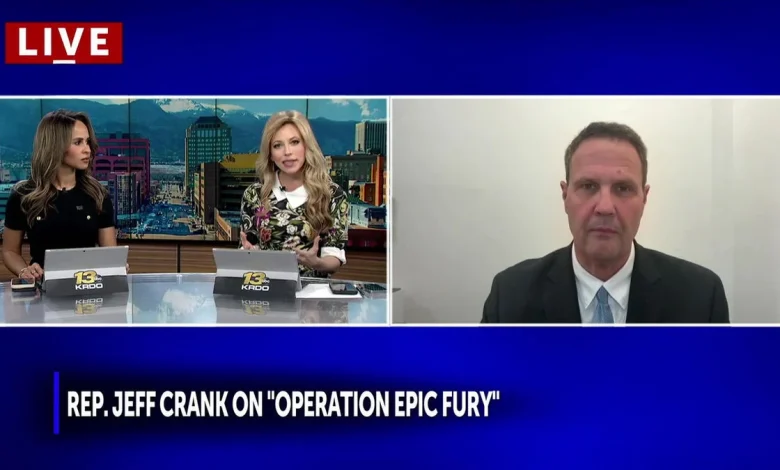
On domestic political reaction, Representative Jeff Crank, a member of the House Armed Services Committee from El Paso County, spoke live in a studio conversation and addressed several themes: the human cost for families, constitutional questions about military action and the role of space assets in the operation. He emphasized support for service members and noted he would give the president broad latitude as commander in chief while acknowledging a preference that Congress be briefed in advance.
- Crank described the loss of life as deeply sad and warned there could be more casualties as the operation continues.
- On constitutional authority, Crank referenced both the Congress’s war powers and the president’s commander‑in‑chief role and cited historical precedent for unilateral deployments.
- Colorado space assets, including GPS and Space Command elements based near Colorado Springs, were identified as playing an early and important role in the operation.
- Crank stressed that the long‑term political outcome for Iran will ultimately be decided by Iranians themselves once the military phase creates conditions for change.
It’s easy to overlook, but this mix of kinetic pressure and political uncertainty leaves a gap that can widen quickly if no clear governance or reconciliation path emerges.
To make sense of what could follow, consider these takeaways drawn from the assessments and statements in recent coverage:
- Escalation without an off‑ramp increases immediate risk to civilians and deployed forces.
- Leadership decapitation in Tehran — including the death of senior figures — creates a power vacuum that will shape who governs next.
- Domestic political debates will center on presidential authority, Congressional involvement and the human costs families face.
- Space and satellite capabilities are playing an operationally early role in supporting the campaign.
Micro timeline (sequence noted in coverage):
- An attack coordinated with allied action struck Iranian leadership and killed senior figures.
- U. S. military operations followed as part of a broader maximum pressure campaign with no named off‑ramp.
- Political figures and former operators offered public assessments emphasizing human cost, constitutional questions and operational inputs.
The real question now is how policymakers will pair military pressure with a viable political plan to limit harm to civilians and U. S. forces while addressing the reported leadership vacuum.
Writer’s aside: What’s easy to miss is how quickly operational advantages — like early space‑based support — can be outpaced by political instability when top leaders are removed; the logistics of governance and protection rarely move as fast as headlines suggest.