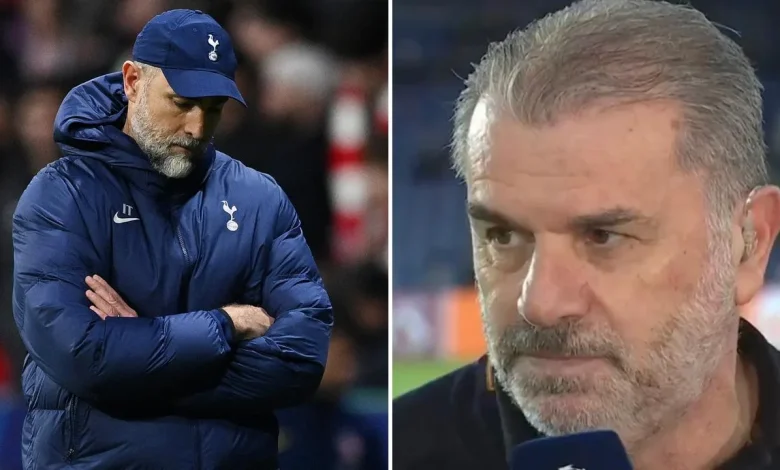
Ange Postecoglou gave a terse “no comment” when asked about a return to Tottenham, as debate intensifies around the club’s crisis. Theo Walcott, speaking while in Sydney for the first leg of his Stan Sport Premier League trophy tour, said Spurs erred in sacking the Australian manager after a successful spell.
Ange Postecoglou Gives ‘No Comment’ On Tottenham Return
Postecoglou joined TNT Sports’ coverage of the PSG v Chelsea Champions League match while in Paris as part of his role on UEFA’s Technical Observer Panel and was pressed on whether he would “return to an ex” in the form of Spurs. He replied “no comment. “
He acknowledged the sensitivity of speaking about his former club, saying “It’s hard for me to say and me speaking about it, kind of, tends to skew the argument. ” He urged easing pressure on the current squad, arguing that outside commentary can complicate matters. He added that Tottenham players were not performing at the levels they were capable of and that the club must deal with its immediate problems.
Postecoglou noted the club’s recent Champions League progress and described Atletico Madrid away as a tough assignment, saying it remained important to take results back to Tottenham. He also reiterated his earlier view that the club had not been behaving like a big football club in terms of the players it was attracting, while stressing it remained a big club based on the scale of support shown last year.
Walcott Backs Postecoglou During Stan Sport Trophy Tour
Theo Walcott, in Sydney for the first leg of his Stan Sport Premier League trophy tour, defended Postecoglou and criticised Tottenham’s decision to dismiss him after the coach had delivered silverware. Walcott praised Postecoglou’s honesty and passion, saying he liked how Postecoglou “laid everything out, says how he sees it. “
Walcott highlighted that Postecoglou won the Europa League with Tottenham last season and pointed out it was the first trophy at the club since the 2008 League Cup. He called the decision to sack Postecoglou a mistake and predicted the polarising manager would return to the Premier League. Walcott also said Postecoglou’s games offered “plenty of goals, plenty of madness, ” recommending fans watch his football.
The former Celtic and Tottenham manager’s recent spell at Nottingham Forest was described in context as brief and unsuccessful: he lasted 39 days, failed to win any of his eight matches, and was dismissed by the club owner. Postecoglou has since re-emerged in media roles and taken time away from the touchline.
Former Players Warn Of Deep Problems As Spurs Slide Continues
Criticism of Tottenham’s current squad and management has mounted amid a run of poor results. Thomas Frank, who replaced Postecoglou, was later fired, and interim boss Igor Tudor has become the first Tottenham manager to lose his first four matches in charge. A 5-2 defeat to Atletico Madrid was part of a sequence that left Spurs with six straight losses for the first time in their history.
Former Tottenham winger Chris Waddle delivered a blunt assessment: “If you’ve got no confidence, don’t play. ” He said the players appeared drained of confidence and warned that many did not look like they wanted to wear the shirt. Waddle urged senior figures to stand up, take responsibility and rebuild unity in the dressing room.
The unfolding situation leaves Tottenham seeking immediate recovery on the pitch while discussions about leadership, recruitment and squad belief continue off it. For now, Postecoglou’s silence on a potential return and public backing from figures such as Walcott add fresh heat to the debate about the club’s direction and the prospects for any short-term rescue under interim management.