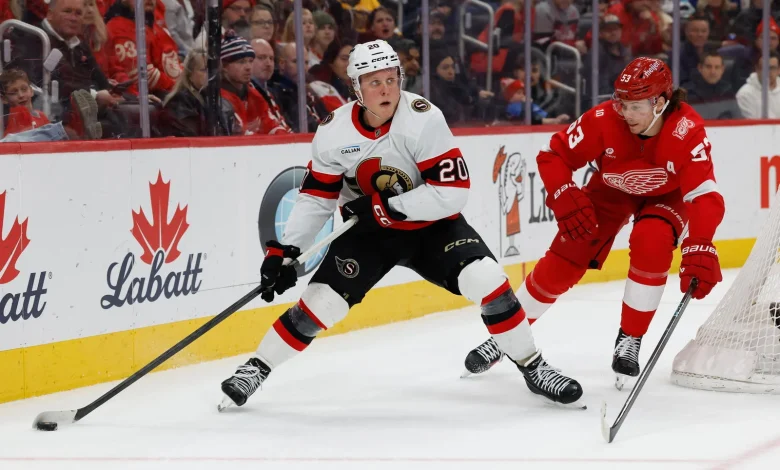
Fabian Zetterlund was part of a midseason exchange that promised to reshape Ottawa’s forward group; a year on, the trade’s upside remains unresolved as on-ice results and prospect outcomes continue to diverge.
Trade Anatomy: Who Moved and What Was Exchanged
At last year’s deadline, Ottawa acquired Fabian Zetterlund, minor-league forward Tristen Robins, and a 2025 fourth-round pick from San Jose in exchange for forwards Zack Ostapchuk and Noah Gregor and a 2025 second-round pick. The package included established NHL pieces, depth forwards and draft capital, meaning a definitive verdict could take years as prospects and picks develop.
Fabian Zetterlund’s Production and Role
The hope in Ottawa was that Zetterlund would provide a top-six scoring boost after back-to-back seasons of strong goal totals in San Jose. His play after the move has been uneven. He finished the regular season following the trade with five points in 20 games and went scoreless in six playoff appearances. In his first full season with the Senators, Zetterlund recorded 12 goals and 12 assists in 65 games but has struggled to earn a consistent spot in the top nine amid a crowded forward group.
Deployment patterns have shifted since the swap. Zetterlund has often logged roughly 9–11 minutes a night on a fourth line, a role resembling the one his former Ottawa trade partner now fills in San Jose. He remains on a three-year contract carrying a $4. 275 million annual cap hit and has two years remaining on that deal, which factors into the team’s roster decisions and expectations about his ability to move up the lineup when needed.
Comparing the Forwards: Ice Time, Style and Salary
The incoming and outgoing forwards offer contrasting profiles. One exchange piece is a larger, more physical skater who brings a physical edge and willingness to engage in fights, standing 6-foot-4 and 212 pounds. Offence has not been his primary output so far, as reflected in five points across 41 games, yet his role and ice time mirror Zetterlund’s current deployment. The salary contrast is stark: the more skilled player carries a $4. 275 million cap hit while the other is at an $825, 000 cap figure.
Those differences—style, production and contract—mean the trade’s value will be judged across multiple dimensions: immediate on-ice contribution, roster fit and long-term cap implications.
Draft Picks, Prospects and Secondary Moves
The draft picks exchanged have already produced tangible outcomes. The Sharks used the surrendered 2025 second-round pick to select Cole McKinney, who represented the United States at the World Junior Hockey Championships and has 19 points in 36 games for the top-ranked University of Michigan. Ottawa’s 2025 fourth-round pick was used to select goaltender Lucas Beckman, who, since being traded from Baie-Comeau, has played 12 games for the Chicoutimi Saguenéens and posted three shutouts along with a 1. 53 goals-against average.
Other players included in the deal did not remain long in the organizations involved. Gregor and Robins both moved on last summer after failing to receive qualifying offers from their new teams; Gregor is now with a different NHL roster while Robins plays in Czechia.
Where the Deal Stands and What Comes Next
It will take years before a definitive winner of the trade can be declared, especially with draft picks and prospect performance in play. For now, the exchange has been slow to show clear dividends for Ottawa on the scoresheet, even as elements of future value—most notably a goaltender selected with the fourth-rounder—have emerged. The player with the larger contract remains capable of moving up the lineup, leaving open the possibility the trade tilts more clearly in Ottawa’s favor, but that outcome is not assured and depends on performance and development in the seasons ahead.