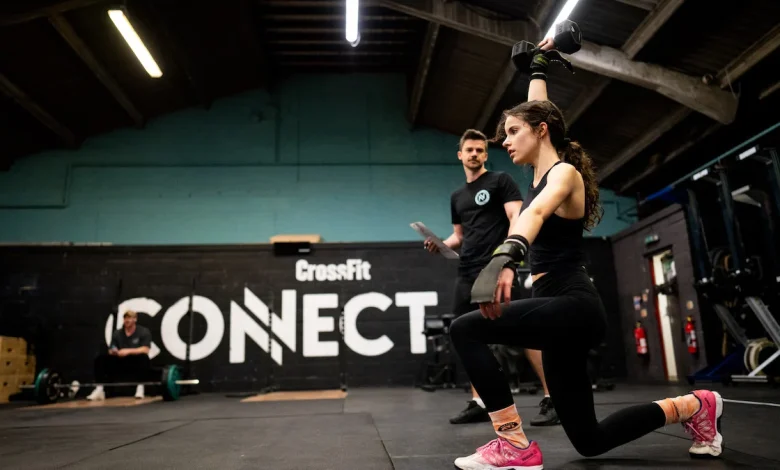
The Crossfit Open 26. 3 Workout has been revealed after a Week 2 test—Workout 26. 2—whose defining features were ring muscle-ups and advanced pulling movements. Jonathan Kinnick documented that 26. 2 carried a 15-minute cap, dramatic pile-ups at the 112th rep, and numbers that expose how muscle-ups reshaped Rx participation and finishing rates.
Workout 26. 2: Jonathan Kinnick’s breakdown of ring muscle-ups, pulls and time caps
Workout 26. 2, presented by Air National Guard, alternated dumbbell snatches, dumbbell overhead walking lunges, pull-ups, chest-to-bar pull-ups, and ring muscle-ups, and imposed a stiff 15-minute time cap. The muscle-ups, placed on rings instead of bars used in prior Opens, proved the biggest bottleneck: 9, 918 women and 41, 773 men completed at least one ring muscle-up. A large pile-up occurred at the 112th rep, and most athletes who moved past that point were time-capped during the first 10 muscle-ups.
Chest-to-bar pull-ups were less prohibitive: over 58, 000 women and 100, 000 men managed at least one rep across all divisions. Still, finishing the Rx’d version was rare—only 4% of women and 13% of men completed all reps inside the time cap. Those numbers frame how technical pulling movements and ring transitions affected athlete outcomes on 26. 2.
Crossfit Open 26. 3 Workout: what 26. 2’s participation and country data suggest
Data from 26. 2 shows advanced pulling movements reduced Rx’d participation compared with Week 1. For women aged 18–34, 70% performed 25. 2 as Rx’d versus 78% on 26. 1. For men aged 18–34, 88% performed 26. 2 as Rx’d compared with 92% on 26. 1. Top countries by Rx’d participation on 26. 2 were South Korea (88%), Australia (84%), and the United States (78%).
Finishing the Rx’d version was especially rare by country: Spain led with a 10. 1% finish rate, followed by Australia and Italy at 8. 4%. When looking specifically at who achieved at least one muscle-up, Australia (29. 5%), Spain (28. 8%), and France (28. 2%) led. These patterns suggest that the Crossfit Open 26. 3 Workout, now revealed as the final Open test, will be judged first by how it challenges athletes on pulling complexity and athlete choices on Rx’d entries.
Scenarios for the Crossfit Open 26. 3 Workout and the Community Cup tiers
If the 26. 2 pattern continues… If the Open keeps emphasizing ring muscle-ups and advanced pulling movements, expect Rx’d participation to stay suppressed and finish rates to remain low. The 15-minute time cap and the 112th-rep pile-up on 26. 2 produced only 4% of women and 13% of men finishing Rx’d; a similar profile in 26. 3 would likely push many athletes to scale and reduce top-tier finish percentages. For the 2026 season, that dynamic will matter because the Community Cup tier you enter is based on the level you receive after submitting scores for all three Open workouts.
Should the 26. 3 workload shift away from cutting pulling complexity… A 26. 3 that lowers the technical pull or muscle-up demand could reverse the 26. 2 trend. Participation at Rx’d levels rose from 25. 2 to 26. 1 in both women and men 18–34 age groups; removing the biggest muscle-up barrier could move Rx’d percentages back toward the 26. 1 figures (78% for women 18–34 and 92% for men 18–34). That would raise the share of athletes finishing Rx’d and change percentile placements used to seed Community Cup tiers.
Based on context data, the next confirmed milestone is athletes submitting scores for all three Open workouts, which determines Community Cup tiers. What the context does not resolve is the exact movement list, rep scheme, or time-cap details of the Crossfit Open 26. 3 Workout beyond its public revelation. For now, the clearest forward signal is how athletes score and submit on the remaining Open test set—those totals will determine tiers and clarify whether the ring muscle-up era seen in 26. 2 carried into the final Open test.