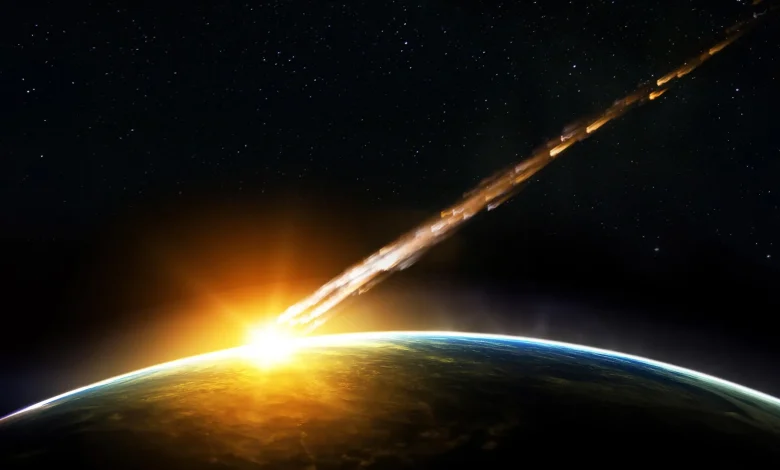
New research led by Dr. Uisdean Nicholson confirms the Silverpit structure beneath the southern North Sea is an impact crater, and the finding ties a 160-metre-wide object to a regional mega-tsunami. The Asteroid Hit North Sea evidence points toward stronger use of seismic imaging and shocked-mineral analysis to settle long-running debates about the feature off Yorkshire.
Silverpit Crater and Dr. Uisdean Nicholson’s seismic and mineral evidence
Scientists led by Dr. Uisdean Nicholson of Heriot-Watt University combined newly available seismic imaging and geological samples to identify microscopic ‘shocked’ quartz and feldspar crystals at the crater floor, confirming impact-level shock pressures. The structure lies about 700 metres beneath the seabed and was identified as a three-kilometre-wide crater with concentric faults spanning about 20 km; those specific measurements anchored the team’s conclusion that Silverpit is an impact site.
Prof Gareth Collins’ modeling, the 160-metre asteroid, and the 1. 5-kilometre water curtain
Modeling in the study reconstructs an object roughly 160 metres wide striking from the west at a shallow angle, throwing up a 1. 5-kilometre-high wall of seawater and shattered rock within minutes. When that wall collapsed, the simulations show it would have produced a colossal tsunami that exceeded 100 metres (330 feet) in height, dwarfing familiar modern storm surges along the ancient North Sea margins.
Asteroid Hit North Sea: age estimates, geography, and the record of debate
Researchers place the impact roughly 43 to 46 million years ago, while related summaries in the context describe the event as occurring approximately 40 million years ago; the two numbers appear in the available material. Silverpit was first detected in 2002 as a bullseye formation about 80 miles off the Yorkshire coast, and a 2009 gathering of geologists voted against an impact explanation before the newer seismic and mineral evidence overturned that conclusion.
| Item | Value from context |
|---|---|
| Asteroid width | 160 metres |
| Crater width | 3 kilometres |
| Concentric faults span | About 20 km |
| Depth beneath seabed | 700 metres |
| Distance off Yorkshire/Hull | Roughly 80 miles |
| Estimated tsunami height | Over 100 metres (330 ft) |
Prof Gareth Collins, who contributed to the new simulations and who attended the 2009 discussion, described the fresh modeling as a decisive element in resolving the dispute. Samples from an offshore oil well yielded the shocked minerals at the same depth as the crater floor, a detail the research team said was critical evidence that could only be produced by extreme impact pressures.
For now, the confirmed state is clear: the Silverpit formation is interpreted as one of Earth’s rare impact craters based on integrated seismic imaging, microscopic analysis, and computer modeling. That resolution overturns earlier alternatives listed in the debate, which included hypotheses about salt movement and volcanic subsidence as causes of the structure.
Scenario A — If the current trajectory of analysis continues: continued use of seismic imaging and targeted sampling like the oil-well cores described will likely consolidate the impact interpretation and supply finer detail on crater structure and wave generation. If the same types of data appear in follow-up work, the regional record of an Asteroid Hit North Sea event will become the baseline for how similar buried craters are identified.
Scenario B — Should age or magnitude estimates shift in future work: if subsequent analyses narrow the timing toward the lower estimate cited in some summaries (around 40 million years) or revise the modeled water-wall height, interpretations of regional environmental effects will change accordingly. Such a shift would alter reconstructions of how widespread the tsunami impact was across ancient North Sea margins.
The next confirmed milestone in the public record from the context is the research appearing in a peer-reviewed journal, and that publication cements the seismic and mineral findings as the new reference point. What the context does not resolve is the apparent discrepancy between the age statements—roughly 43 to 46 million years versus approximately 40 million years—and how that gap affects finer details of regional timing.
That acknowledged gap leaves a narrow, concrete task for follow-up work: reconcile the age estimates using the seismic images and shocked-mineral data already described, then use the refined chronology to map where a mega-tsunami of the modeled scale would have struck around the ancient North Sea margins.