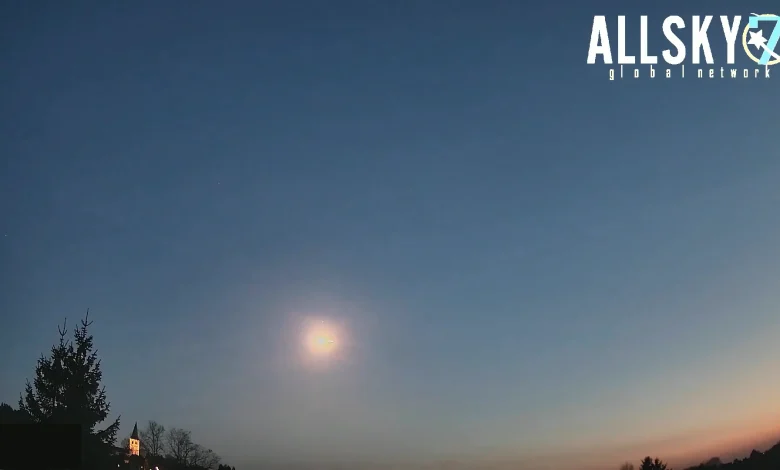
At approximately 18: 55 CET (17: 55 UTC) on Sunday 8 March 2026, a very bright fireball moved from the southwest to the northeast across Belgium, France, Germany, Luxembourg and the Netherlands, glowed for about six seconds and fractured, sending small meteorites that struck at least one house in Koblenz-Güls. ESA’s Planetary Defence team is analysing the meteorite germany event to estimate the object’s size and to understand why it likely escaped detection by large-scale telescope surveys.
Meteorite Germany Koblenz-Güls impact
At least one house in the German town of Koblenz-Güls is reported to have been struck by small pieces of the resulting meteorites, and local accounts describe a hole roughly the size of a football in a roof with at least one fragment reaching a bedroom. There are no reports of physical injury in connection with the event. The pattern suggests that while fragments retained enough mass and kinetic energy to breach roofing in Koblenz-Güls, the human toll was limited in this instance.
ESA Planetary Defence analysis
ESA’s Planetary Defence team is using all available data to estimate the size of the object and currently assesses it to have been up to a few metres in diameter; objects in this size range hit Earth from once every few weeks to once every few years. The timing and direction of the impact indicate the object was likely not visible to any of the large-scale telescope sky surveys that scan the night sky, a pattern ESA identifies as common for small objects approaching from brighter parts of the sky around dusk. The figures point to persistent detection gaps for small, dusk-approaching objects and explain why ESA is pursuing projects such as the Flyeye asteroid survey telescope to improve pre-impact discovery rates.
AllSky7 fireball network recordings
The fireball was recorded by dedicated meteor cameras, including the European AllSky7 fireball network, as well as by mobile phones and other cameras; some observers also reported hearing the event from the ground. The phenomenon glowed for approximately six seconds, left a visible trail in the sky and then fractured into pieces. The pattern suggests these multiple recordings and eyewitness accounts are the observational backbone ESA’s Planetary Defence team will use to reconstruct the trajectory, fragmentation and to refine the size estimate for the meteorite germany event.
ESA has said it will provide further updates as new information becomes available. If the agency’s analysis confirms an object up to a few metres across, the data suggests that similar-sized objects will continue to reach the atmosphere with intervals measured in weeks to years and that improved survey capability will be needed to raise the pre-entry detection rate.