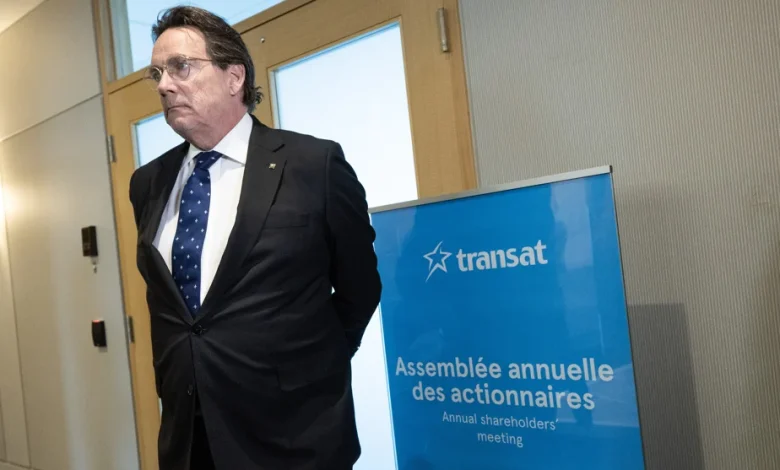
Shareholders rejected the slate put forward by pierre karl péladeau and elected the eight directors proposed by Transat, handing a clear victory to the company’s management team. The outcome signals a near-term consolidation of board control while leaving open how and when pierre karl péladeau might renew his challenge.
Transat Elects Eight Directors; Vote Totals and Institutional Backing
Transat’s eight candidates were elected with backing ranging from 71. 9% to 74. 6% of the votes cast, while the slate linked to Financière Outremont failed to secure seats. Financière Outremont, controlled by pierre karl péladeau, holds about 9. 5% of Transat’s shares. Two institutional investors—the Fonds de solidarité FTQ and La Caisse—publicly supported management during the vote, holding roughly 11% and 6% of the company’s stock respectively. Management also reduced the size of the board from 11 to eight members ahead of the meeting to streamline governance and, executives said, to improve efficiency.
Pierre Karl Péladeau’s Proposal: Board Seats, Debt Objections, and Capital Offers
Pierre Karl Péladeau had proposed shrinking the board to six members and taking a seat alongside two associates, André Brosseau and Jean‑Marc Léger, which would have given him control of half the board. He repeatedly criticized the restructuring agreement struck with the federal government that makes the government Transat’s main creditor, noting the company’s debt stood at 375 million dollars as of January 31. He objected in particular to a clause that channels half of funds raised through investments or asset sales to repay creditors, and said he was open to injecting tens of millions into the parent company—so long as that capital could remain in the business rather than reduce the debt.
Scenarios for Transat and Pierre Karl Péladeau’s Next Moves
Scenario A: If shareholder support for management continues… If votes remain in the 71. 9%–74. 6% range for management-backed directors and institutional holders like the Fonds de solidarité FTQ and La Caisse continue to align with the company, Transat’s board will keep the current eight-member structure and the company will have space to press its operational plan. For now, Transat has reported improving financial performance over November, December and January with revenue growth, a reduced loss, and nearly doubled free cash flow—signals that strengthen management’s case for focusing on execution and debt reduction rather than governance change.
Scenario B: Should pierre karl péladeau shift strategy or press renegotiation… If pierre karl péladeau pivoted from a shareholder slate to a different approach—pursuing a renegotiation of the federal debt arrangement or formally offering capital with new terms—he might change the calculus of other investors. He has said he wants the loan conditions revisited and has signaled willingness to inject significant sums; should he present a concrete renegotiation proposal or capital plan that addresses the clause tying new funds to debt repayment, the dynamic among holders and with the government creditor could alter.
That said, Transat’s management emphasized stability after the meeting. Daniel Desjardins, an independent director who commented after the vote that shareholders had expressed support for Transat, framed the result as a mandate for focus rather than distraction. Annick Guérard, the chief executive named in context, declined to answer questions at the meeting, and company they continue discussions with the federal government about the loan conditions without providing details.
The next confirmed signal from the context will be any subsequent episode in the dispute between Transat and Pierre Karl Péladeau—whether a renewed slate, a formal capital proposal, or public progress in talks with the federal creditor. What the context does not resolve is the specific strategy pierre karl péladeau will use to return to the fight; that will be resolved when he outlines a concrete plan or mounts another push that changes investor alignments or the terms of the government agreement.