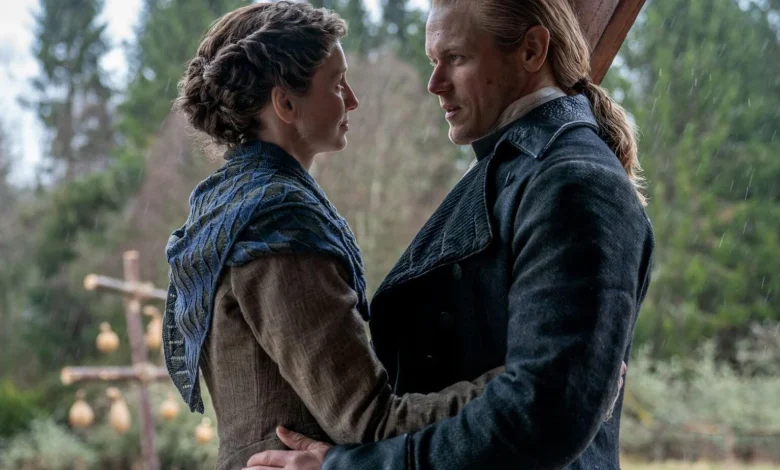
The final season of the long-running drama arrives with a disorienting emotional question at its center: in outlander season 8 Claire’s long-buried grief is reopened by the possibility that a child thought lost might be alive. The season, premiering March 9 at 9: 00 pm ET, pushes the principal characters into choices the production says were liberated by moving beyond the exact path of the source books. For viewers and the actors, that creative leeway has sharpened personal and narrative stakes.
Outlander Season 8 — Background and Stakes
After eight seasons, the show’s final block of episodes reframes the series’ central attachments. The production has explicitly leaned on the original novels where helpful while expanding beyond them when needed: “We mined the books for as much as we could use, and then to bolster that story with the new stuff, ” said Matthew B. Roberts, showrunner and producer, Outlander (the series). That approach, he said, allowed the writers to keep Jamie and Claire as the gravitational center of storylines without inventing an entire new trajectory.
The season places Claire in a uniquely fraught emotional state. Executive producer Maril Davis, executive producer, Outlander (the series), characterized the story choice as a deepening of Claire’s internal life: Claire has carried the belief for roughly two decades that a stillborn daughter, Faith, was lost — and the suggestion that Faith may have lived reactivates longstanding trauma. That reopened grief, Davis said, raises the season’s emotional stakes and propels Claire into decisions with family-wide consequences.
Deep Analysis: Grief, Death and Narrative Freedom
The decision to foreground a reopened maternal grief functions narratively in two ways. First, it provides immediate emotional momentum for the season’s opening episodes: Claire’s laboring to reconcile memory and possibility becomes a catalyst for action. Caitríona Balfe, actor, Outlander (the series), described the role as carrying “a grief that never leaves you, ” and noted that performing years of accumulated scenes makes past emotional beats resurface physically and mentally in new scenes. Second, the show’s willingness to depart from the strict book chronology gives writers latitude to heighten personal consequences without invoking unsupported conjecture about the novels.
Parallel to Claire’s internal upheaval, the season interrogates mortality through Jamie’s arc. Sam Heughan, actor, Outlander (the series), framed Jamie as someone who has repeatedly faced death but who now understands more clearly “what he’s leaving behind. ” That recalibration—of a character long treated as nearly indestructible—complicates risk on screen and reframes familiar survival tropes. Roberts reiterated that Jamie’s convictions about an afterlife and his dedication to Claire remain central: “He fully believes there’s something else, and he will be with Claire there no matter what. “
Cast Perspectives, Legacy and What Comes Next
Across the ensemble, the end of filming brought private and professional reckonings. Members of the cast reflected on the series’ long arc: since filming began in Scotland in 2013, the production has tracked with major life events for many involved, and the show’s debut in 2014 coincided with shifting attitudes toward televised romance. Maril Davis noted a cultural appetite for enduring love stories, and the cast echoed how that theme informed their shared experience. John Bell, actor, Outlander (the series), recalled auditioning as a pivotal moment early in his career, and Richard Rankin, actor, Outlander (the series), described the surreal quality of shooting final scenes with colleagues who were wrapping their storylines.
The final season’s emotional tone was not only personal but collective: Sam Heughan described cycles of quotidian work punctuated by sudden awareness that a block of filming or an episode was the last, creating a roller-coaster of sentiment among cast and crew. That sense of ending amplifies the narrative choices visible on screen and complicates audience expectations about resolution.
With outlander season 8 positioned as both a conclusion and a creative departure from published material, the season tests how an established love story endures when its center is shaken by possible revelations about loss and survival. The show’s last run asks whether newly revealed facts can be reconciled with lifelong grief and whether characters who have survived repeated near-death experiences can accept the costs of what they leave behind — questions that will determine how viewers remember this long-running romance and its final shape in outlander season 8.
As the series concludes, cast and producers have emphasized that while the production drew heavily on antecedent texts, the freedom to extend and reinterpret those threads produced intense, sometimes unpredictable, emotional work; that work, in turn, will determine how the narrative resolves and how the show’s legacy is read in the years to come. What will remain with audiences after the final frame of outlander season 8 — grief transformed into purpose, or grief unresolved — is the central question the season sets out to answer.