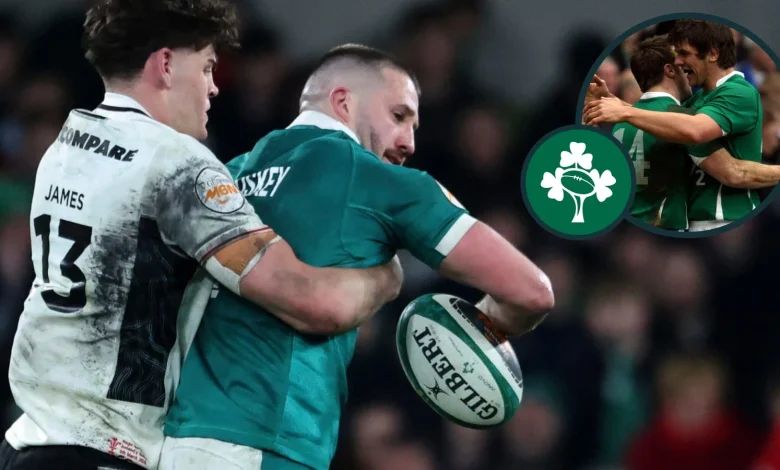
Ireland’s goalkicking is under renewed scrutiny ahead of Scotland’s visit to Dublin, with jack crowley at the center of a wider debate over accuracy, technique, and selection as the Six Nations reaches its final round.
Jack Crowley’s Technique Under The Microscope
Scrutiny intensified this week as former fly-half Ian Madigan and journalist Cian Tracey dissected jack crowley’s place-kicking mechanics following recent misses. Their discussion formed part of a broader look at Andy Farrell’s selection calls and Scotland’s mindset before the decisive clash in Dublin. The focus on technique reflects a deeper unease: Ireland’s kickers are leaving points on the field at a rate that could prove decisive if the match tightens late.
That tension rose after Ireland’s win over Wales, where the result was secure but the finishing lacked conviction. The kicking spotlight has grown from individual misses into a strategic question for the coaching staff heading into a fixture that doubles as a sprint for the Triple Crown.
Data Paints A Worrying Picture Off The Tee
Opta data places Ireland’s expected goalkicking success in this year’s championship at 83. 5 percent, second-best among the teams. The actual return, however, sits at 70 percent—the lowest in the tournament and the only mark below expectation. In practical terms, Ireland are missing kicks that historical trends suggest should be made.
Sample size is a caveat—six missed kicks across four games—but the locations of those attempts matter. Misses by Sam Prendergast against Italy and by Jack Crowley against Wales came from relatively straightforward positions, inflating the gap between expected and actual outcomes. That underperformance complicates tactical decision-making against a Scotland side with scoring threats scattered across the park.
Form across the domestic season underlines the selection dilemma. The most accurate kicker operating in Irish rugby this year is Connacht’s Sam Gilbert at 89 percent, but he is not Irish-qualified. Seán Naughton, also at Connacht, is tracking at 88 percent. Among those in the national frame, Harry Byrne is at 76 percent, while Crowley is a touch above 75 percent, alongside Nathan Doak. Prendergast has struggled at 68 percent. Two others—Ulster’s Jake Flannery at 100 percent and Leinster’s Charlie Tector at 83 percent—have attempted fewer than 10 kicks and were set aside from the analysis. The only kickers above 80 percent are a non–Irish-qualified option and a pair of 21-year-olds, including Jack Murphy and Naughton, who are not first-choice kickers at their provinces.
Key figures from the current season:
- Expected goalkicking in the championship: 83. 5%
- Actual goalkicking in the championship: 70%
- Top domestic marks: Sam Gilbert 89% (not Irish-qualified), Seán Naughton 88%
- In contention: Harry Byrne 76%, Jack Crowley just over 75%, Nathan Doak 75%, Sam Prendergast 68%
On paper, the margins look fine. In a likely high-pressure finish, those margins could decide a title chase.
Selection Stakes And A Blueprint For Scotland
Beyond the tee, prominent former internationals Tommy Bowe and Donncha O’Callaghan voiced concerns that Ireland’s attack appeared one-dimensional in the win over Wales. They highlighted the absence of an enforcer, a shortage of variety in the kicking game—citing a lack of cross-field options or deft chips—and a need for sharper plays from set-piece launches. Their view is that Wales offered Scotland a defensive template by contesting fewer rucks, stretching the field, and stifling Ireland’s rhythm—“breadcrumbs, ” as O’Callaghan framed it, that could be used in Dublin.
Scotland arrive with confidence, buoyed by recent form and their title pursuit. The contest in Dublin is a direct fight for the Triple Crown, a piece of silverware Ireland have grown accustomed to lifting in recent seasons. Scotland, by contrast, are seeking to end a long wait for that particular honor and have fresh momentum from a high-scoring victory over France in Edinburgh. The stakes are immediate: Scotland are aiming to break Ireland’s extended winning streak in this fixture and puncture a run that spans major tournaments.
All of which sharpens the focus on Farrell’s choices: who kicks, from where on the field, and how often Ireland lean on the posts instead of the corner. The team’s expected accuracy suggests the process is sound; the recent returns say the execution must improve now. If Saturday’s game compresses into a one-score finish, Ireland’s ability to turn pressure into points from the tee may define the outcome.
With the margins fine and the data stark, the question for Ireland is less about potential than reliability under stress. The answer may come one strike at a time.